Everything You Need to Know in Geometry
Introduction to Geometry:
Points, Lines, Planes and Dimensions
Run across also: Calculating Surface area
When yous outset studying geometry, it is important to know and understand some bones concepts.
This page volition assistance you lot understand the concept of dimensions in geometry, and piece of work out whether you are working in one, two or three dimensions.
Information technology also explains some of the bones terminology, and points you to other pages for more information.
This page covers points, lines, and planes.
Other pages in this serial explain nigh angles and shapes, including polygons, circles and other curved shapes, and three-dimensional shapes.
What is Geometry?
Geometry, n. that part of mathematics which treats the properties of points, lines, surfaces and solids…
Chambers English Lexicon, 1989 edition
Geometry comes from the Greek meaning 'earth measurement' and is the visual study of shapes, sizes and patterns, and how they fit together in infinite. You will find that our geometry pages contain lots of diagrams to help you lot understand the subject.
When you're faced with a problem involving geometry, it can be very helpful to draw yourself a diagram.
Working in Different Dimensions
No, not the space-fourth dimension continuum! We're talking about shapes that are in ane, two and iii dimensions.
That is, objects that take length (one dimension), length and width (two dimensions) and length, width and depth or height (three dimensions).

Points: A Special Case: No Dimensions
A point is a single location in space. It is often represented by a dot on the folio, simply actually has no real size or shape.
You cannot describe a signal in terms of length, width or height, so it is therefore non-dimensional. However, a indicate may be described past co-ordinates. Co-ordinates do not define anything nearly the bespeak other than its position in space, in relation to a reference bespeak of known co-ordinates. Yous volition come up across point co-ordinates in many applications, such as when you lot are drawing graphs, or reading maps.
Almost everything in geometry starts with a betoken, whether it'due south a line, or a complicated three-dimensional shape.
Lines: 1 Dimension
A line is the shortest altitude between two points. It has length, but no width, which makes information technology one-dimensional.
Wherever two or more than lines meet, or intersect, there is a point, and the two lines are said to share a point:

Line segments and rays
There are two kinds of lines: those that have a defined start- and endpoint and those that go on for always.
Lines that move betwixt two points are called line segments. They beginning at a specific point, and go to some other, the endpoint. They are drawn every bit a line between two points, as you would probably expect.

The second type of line is called a ray, and these go on forever. They are often fatigued every bit a line starting from a betoken with an arrow on the other stop:

Parallel and perpendicular lines
There are two types of lines that are especially interesting and/or useful in mathematics. Parallel lines never meet or intersect. They simply get on forever adjacent, a bit like railway lines. The convention for showing that lines are parallel in a diagram is to add together 'feathers', which look like pointer heads.

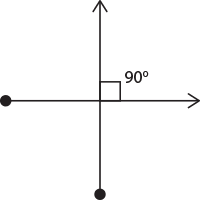
Perpendicular lines intersect at a right angle, 90°:
Planes and 2-dimensional Shapes
Now that nosotros accept dealt with one dimension, it'due south time to motion into 2.
A aeroplane is a flat surface, likewise known as two-dimensional. It is technically unbounded, which means that it goes on for ever in any given direction and as such is impossible to depict on a page.
I of the cardinal elements in geometry is how many dimensions you're working in at any given time. If y'all are working in a single plane, and so it's either 1 (length) or ii (length and width). With more than one airplane, it must be three-dimensional, because height/depth is also involved.
2-dimensional shapes include polygons such every bit squares, rectangles and triangles, which have straight lines and a signal at each corner.

In that location is more nigh polygons in our page on Polygons. Other two-dimensional shapes include circles, and whatsoever other shape that includes a curve. Yous can detect out more than about these on our page, Curved Shapes.
Three Dimensions: Polyhedrons and Curved Shapes
Finally, there are likewise 3-dimensional shapes, such every bit cubes, spheres, pyramids and cylinders.
To learn more about these see our page on 3-Dimensional Shapes.
Signs, Symbols and Terminology

The shape illustrated here is an irregular pentagon, a five-sided polygon with unlike internal angles and line lengths (see our page on Polygons for more about these shapes).
Degrees ° are a measure of rotation, and define the size of the angle betwixt two sides.
Angles are commonly marked in geometry using a segment of a circumvolve (an arc), unless they are a right angle when they are 'squared off'. Angle marks are indicated in green in the example here. Run into our page on Angles for more information.
Tick marks (shown in orange) indicate sides of a shape that have equal length (sides of a shape that arecongruent or that match). The single lines show that the two vertical lines are the same length while the double lines show that the two diagonal lines are the same length. The bottom, horizontal, line in this example is a different length to the other iv lines and therefore not marked. Tick marks tin can also be chosen 'hatch marks'.
A vertex is the point where lines encounter (lines are besides referred to every bit rays or edges). The plural of vertex is vertices. In the example at that place are five vertices labelled A, B, C, D and E. Naming vertices with letters is common in geometry.
In a closed shape, such every bit in our example, mathematical convention states that the letters must always be in society in a clockwise or counter-clockwise direction. Our shape tin can be described 'ABCDE', but it would be wrong to label the vertices so that the shape was 'ADBEC' for instance. This may seem unimportant, but it is crucial in some complex situations to avoid confusion.
The bending symbol '∠' is used as a shorthand symbol in geometry when describing an bending. The expression∠ABCis shorthand to describe the angle betwixt points A and C at betoken B. The middle letter of the alphabet in such expressions is ever the vertex of the angle you lot are describing - the society of the sides is not important.∠ABC is the aforementioned every bit∠CBA,and both describe the vertexBin this example.
If you lot want to write the measured angle at point B in autograph then you lot would apply:
m∠ABC = 128° (m simply means 'mensurate')
or
thousand∠CBA = 128°
In our example nosotros can also say:
m∠EAB=xc°
1000∠BCD=104°
Why Practise These Concepts Matter?
Points, lines and planes underpin well-nigh every other concept in geometry. Angles are formed between two lines starting from a shared point. Shapes, whether ii-dimensional or three-dimensional, consist of lines which connect upwards points. Planes are important because 2-dimensional shapes take simply ane plane; iii-dimensional ones have two or more.
In other words, you really need to sympathize the ideas on this page earlier you can move on to any other expanse of geometry.
Farther Reading from Skills You Need
The Skills You Need Guide to Numeracy

This four-function guide takes yous through the basics of numeracy from arithmetic to algebra, with stops in between at fractions, decimals, geometry and statistics.
Whether yous want to brush up on your basics, or help your children with their learning, this is the volume for you.
Source: https://www.skillsyouneed.com/num/geometry.html
0 Response to "Everything You Need to Know in Geometry"
Post a Comment